SRM Kattankulathur Dental College and Hospital, Kattankulathur
Ranked #19 by NIRF, NAAC A++ Accredited | Recognized by dental council of India


The NCERT Books for NEET 2027 are some of the most significant study materials for NEET 2027 preparation in Physics, Chemistry and Biology. The NCERT Books for Class 11 and 12 include the basic concepts which are part of the NEET syllabus and are highly useful for Biology and Inorganic Chemistry. Students need to complete the NCERT chapters first before proceeding further with other study materials.
This Story also Contains
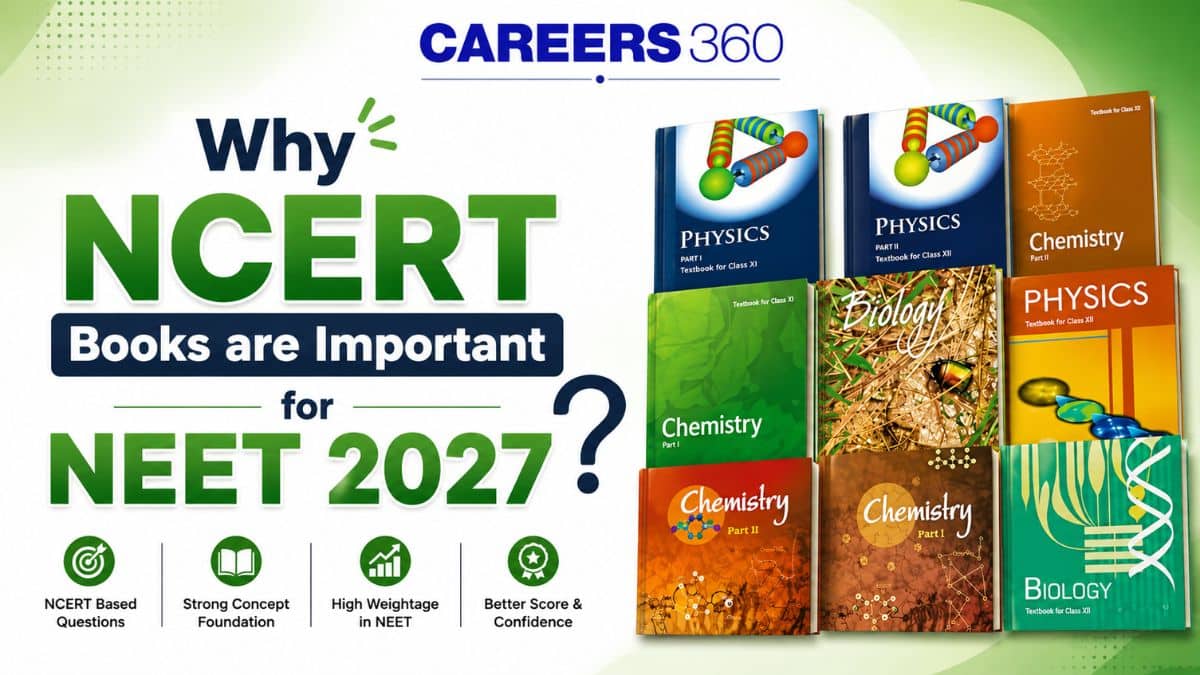
Candidates can refer to the NCERT Books for NEET 2027 PDF for Physics, Chemistry and Biology and then proceed with solving previous years' questions, NEET Exam MCQs and mock tests.
NCERT Books of Class 11 and Class 12 are essential for candidates who are preparing for NEET 2027. The concepts which are covered in the NCERT books help students to understand the basics and fundamentals and they are especially significant for Biology and Inorganic Chemistry subjects. Candidates must read the specified NCERT chapters and then refer to PYQs, MCQs and other reference books. To do better, you can also practice with NCERT-based MCQ for NEET Biology and other subjects.
Here is a list of the recommended NCERT books for the NEET 2027 exam:
Subject | NCERT Books Required | Importance |
Biology | Class 11 Biology + Class 12 Biology | Very High |
Chemistry | Class 11 Chemistry Part I & II + Class 12 Chemistry Part I & II | Very High |
Physics | Class 11 Physics Part I & II + Class 12 Physics Part I & II | High |
These books are available both offline and online in PDF format, which makes them easy to read and understand for every NEET 2027 aspirant.
Get expert advice on college selection, admission chances, and career path in a personalized counselling session.
The benefits of studying NCERT for 2027 aspirants are many. NCERT books are the backbone of NEET preparation, providing simplicity, syllabus alignment and high-yield material. Knowing why NCERT books are important can actually increase your chances of scoring marks.
NCERT books are really good because they follow the syllabus. This means you only study what you need to know, and you do not waste time on things that're not important. A lot of the questions on the NEET exam in Biology come from NCERT books. They take the diagrams, examples and explanations from these books. The NCERT books explain things in a detailed way, which makes the concepts easy to understand. This helps you build a base of knowledge which is necessary for solving problems that need you to apply what you have learned. NCERT books are very helpful for this reason.
NCERT books and the NEET syllabus are perfectly aligned. The NEET syllabus is largely based on the NCERT Class 11 and 12 books. Hence, they are the first choice of students. By learning from the NCERT books, you will be able to cover all the topics given by the National Testing Agency (NTA) in the syllabus along with the high-weightage topics for the exam.
The NEET syllabus, as made available by the NTA, aligns with the chapters and concepts described in the NCERT textbooks. From Biology to Chemistry and Physics, the fundamental topics are described chapter-wise; hence learning from the NCERT books assures syllabus coverage.
Here is the class-wise distribution:
Ranked #19 by NIRF, NAAC A++ Accredited | Recognized by dental council of India
Special Scholarship for Students from Goa (Get an exclusive scholarship of ₹20,000 if you're a Goa-based student) | Bringing Parul Education Trust's 30-year Education Legacy to Goa
Many diagrams, definitions and example-based questions are directly taken from the NCERT books in the exam. Flowcharts and labelled diagrams are regularly repeated, so the NCERT books are crucial for candidates who desire scores.
Unlike reference books that may differ in explanations, NCERT textbooks offer standardized syllabus-tested material limiting the chances of learning topics.
There is no fixed figure or percentage of NEET questions which NTA considers as direct from NCERT. This figure may change from one paper to another and from one subject to another.
But previous NEET papers and current studies indicate that NCERT holds special significance in the preparation of Biology and Inorganic Chemistry. NCERT was found to be the major source for Biology 2026 but included other types of questions as well, like conceptual, statement-based, and application-based questions.
Hence, instead of believing in myths like a certain number of questions from NCERT, students should work on their NCERT preparation and their application part.
NCERT textbooks play a critical role in every NEET subject, but their importance varies by subject. Understanding this can help you prioritise your study strategy and maximise your score.
Biology: NEET Biology questions (80–90%) are directly based on the NCERT books. Diagrams like the heart, nephron and photosynthesis flowcharts often appear verbatim. Memorising NCERT examples, terms and definitions is important as they are frequently repeated. Genetics, Ecology, Human Physiology, Plant Physiology and Biotechnology are the important units.
Chemistry: NCERT books are the source for definitions, reactions and theory, particularly in Inorganic Chemistry. Physical Chemistry and Organic Chemistry require problem-solving, and NCERT books provide examples, but reference books help with advanced numericals. Chemical Bonding, Coordination Compounds, Electrochemistry and Organic Reaction Mechanisms are high-weightage chemistry chapters.
Physics: NCERT books help build the concepts required to solve application-based questions. While some NEET Physics numericals come directly from the NCERT books, additional practice from reference books is needed for scores. Mechanics, Electrostatics, Current Electricity, Optics and Modern Physics are the most scoring NEET chapters.
There are many advantages to studying NCERT comprehensively:
It provides a firm conceptual base
Helps in covering the NEET syllabus
Enhances preparation in Biology
Helps in revision of Inorganic Chemistry
Provides standard definitions and nomenclature
Facilitates understanding of diagrams and other processes
Helps in problem-solving using PYQs
Doesn’t require referring to multiple books
Serves as a good basis for revision
But NCERT should never be used as the sole study material for each subject. This especially applies to subjects like Physics and Physical Chemistry.
Frequently Asked Questions (FAQs)
NCERT books are very important for NEET, especially Biology, but extra books and practice are needed for Physics and Chemistry.
Some important books for NEET Biology preparation are NCERT class 11 and 12, Biology Vol 1 and Vol 2 by Trueman and Objective Biology by Dinesh
Clearing NEET without NCERT is very difficult because most Biology questions and many Chemistry concepts are directly based on NCERT.
No, NEET is not totally based on NCERT, but a major portion of Biology and many concepts in Chemistry and Physics come directly from NCERT. Aspirants might need extra practice in physics and chemistry beyond that.

On Question asked by student community
Hello Students,
For the NEET UG 2026 Question Paper PDF with Answer Key and Solutions, refer to the article below:
https://medicine.careers360.com/articles/neet-previous-year-question-paper-with-solution
Hello Student,
You can check the resource provided below:
Download NEET Previous 10 Years Question Papers with Solutions PDF
You can also check the NEET 2026 question paper with solutions
Hope this helps!
Hello Chetan,
Here are the links you asked for. I hope they serve your purpose.
Hello Suma,
Here are the links you asked for. I hope they serve your purpose.
Hello Bhanuday,
Here are the links you requested. I hope you find them helpful.
the product 'P' will be ,


| Column A | Column B |
| A |
a) Organisation of cellular contents and further cell growth. |
| B |
b) Leads to formation of two daughter cells. |
| C |
c) Cell grows physically and increase volume proteins,organells. |
| D |
d) synthesis and replication of DNA. |
Match the correct option as per the process shown in the
0.16 g of dibasic acid required 25 ml of decinormal solution for complete neutralisation. The modecular weight of the acid will be
32
64
128
256
0xone is

Ranked #19 by NIRF, NAAC A++ Accredited | Recognized by dental council of India
Special Scholarship for Students from Goa (Get an exclusive scholarship of ₹20,000 if you're a Goa-based student) | Bringing Parul Education Trust's 30-year Education Legacy to Goa
Ranked among the top Dental Colleges for 7 consecutive years by India Today poll